

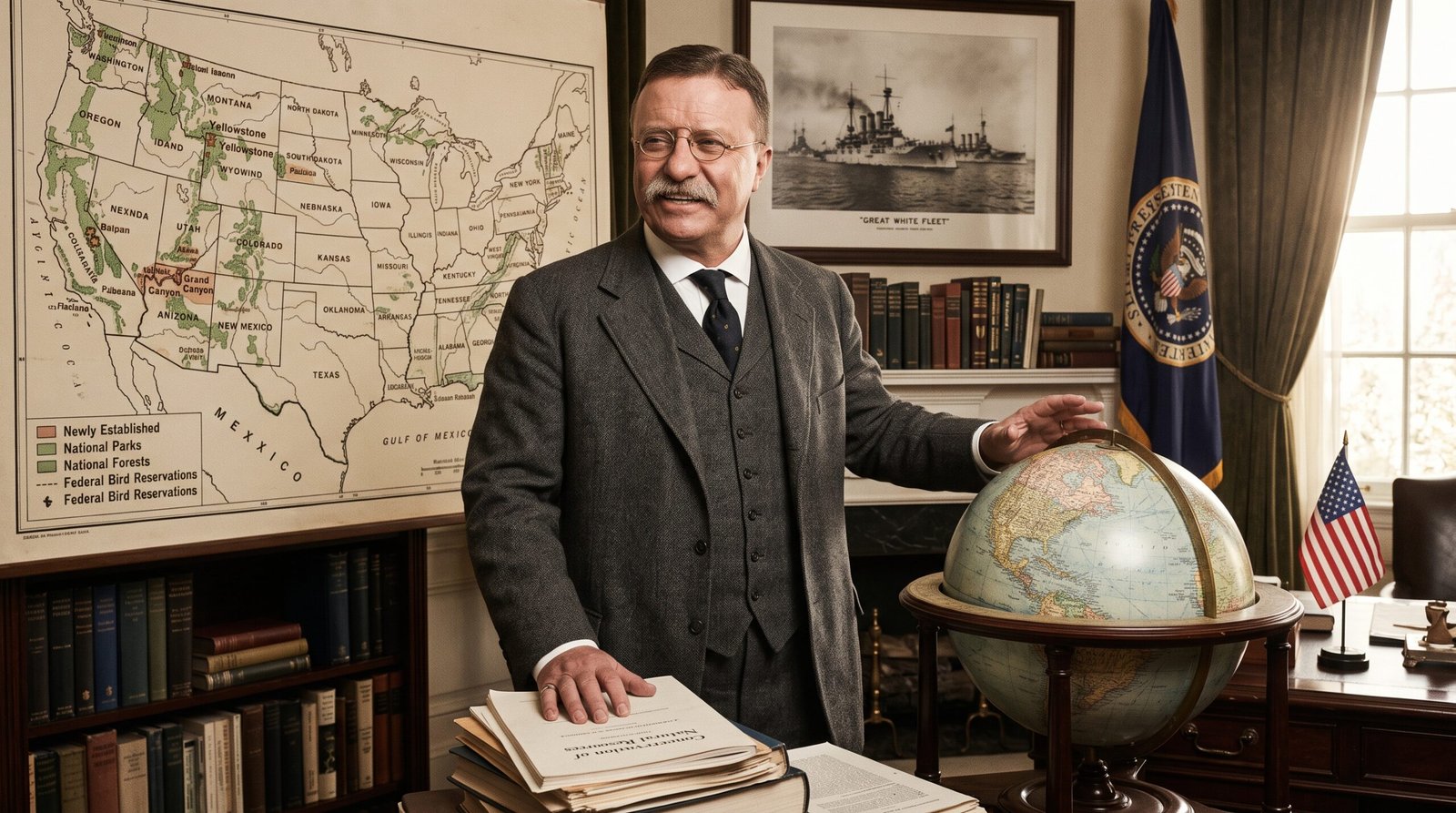
Theodore Roosevelt was one of the most influential and admired leaders in American history. American history. As the 26th President of the United States, he served from 1901 to 1909 and transformed the nation through progressive reforms, conservation efforts, and strong leadership. Roosevelt believed that government should work for the people by ensuring fairness, protecting natural resources, and promoting economic opportunity. His energetic personality, determination, and willingness to challenge powerful interests earned him a lasting place among America’s greatest presidents.
Known for his famous motto, “Speak softly and carry a big stick,” Roosevelt combined diplomacy with strength in both domestic and foreign policy. His presidency marked a turning point in American politics, making the federal government more active in protecting citizens and preserving the country’s natural beauty. Today, his legacy continues to inspire leaders, historians, and citizens around the world.
Early Life and Education
Theodore Roosevelt was born on October 27, 1858, in New York City. As a child, he suffered from severe asthma and poor health. Instead of allowing these challenges to define him, Roosevelt worked hard to improve his physical strength through exercise, outdoor activities, and determination.
He attended Harvard University, where he excelled academically and developed a lifelong interest in history, politics, and natural science. After graduating in 1880, Roosevelt entered public service, beginning a remarkable political career that would eventually lead him to the White House.
His early experiences taught him the value of perseverance, courage, and self-discipline—qualities that shaped his future leadership.
Entry into Politics
Roosevelt began his political career as a member of the New York State Assembly. He quickly gained a reputation for honesty and fighting corruption. Throughout his early career, he served in several important government positions, including:
- Member of the New York State Assembly
- U.S. Civil Service Commissioner
- President of the New York City Board of Police Commissioners
- Assistant Secretary of the Navy
- Governor of New York
Each position strengthened his experience and prepared him for national leadership.
The Rough Riders and the Spanish-American War
In 1898, during the Spanish-American War, Roosevelt resigned as Assistant Secretary of the Navy to form a volunteer cavalry regiment known as the Rough Riders.
The unit became famous after its courageous charge up San Juan Hill in Cuba. Roosevelt’s bravery made him a national hero and greatly increased his popularity among the American people.
Many years later, he was posthumously awarded the Medal of Honor for his leadership during the war.
Becoming President
In 1900, Roosevelt was elected Vice President under President William McKinley. When McKinley was assassinated in 1901, Roosevelt became president at the age of 42, making him the youngest person ever to assume the U.S. presidency.
His youthful energy, confidence, and determination immediately transformed the White House into a center of active leadership.
Progressive Reforms
One of Roosevelt’s greatest achievements was promoting progressive reforms that improved American society.
His administration focused on making government more responsive to ordinary citizens instead of powerful corporations.
Major reforms included:
- Fighting monopolies through trust-busting policies.
- Regulating large railroad companies.
- Protecting consumers from unsafe food and medicines.
- Improving workplace conditions.
- Promoting fairness in business practices.
Roosevelt believed that economic success should benefit everyone rather than a small group of wealthy individuals.
The Square Deal
Roosevelt introduced the Square Deal, a domestic program based on three main principles:
Fairness for Workers
He supported better working conditions and encouraged peaceful solutions to labor disputes.
Consumer Protection
His administration passed important laws that improved food safety and medicine quality, increasing public confidence.
Business Regulation
Roosevelt believed businesses should grow, but they should operate fairly and obey the law.
The Square Deal helped establish the federal government’s role in protecting citizens.
Conservation and Environmental Leadership
Theodore Roosevelt is widely regarded as America’s greatest conservation president.
He believed that forests, rivers, wildlife, and natural landscapes belonged to future generations as well as the present.
His environmental achievements include:
- Creating five national parks.
- Establishing 18 national monuments.
- Protecting over 150 national forests.
- Creating dozens of wildlife refuges.
- Conserving more than 230 million acres of public land.
His conservation policies created the foundation for modern environmental protection in the United States.
Many of America’s most beautiful natural areas remain protected today because of Roosevelt’s vision.
Foreign Policy
Roosevelt expanded America’s influence around the world through diplomacy backed by military strength.
His famous foreign policy philosophy was:
“Speak softly and carry a big stick.”
This meant resolving conflicts peacefully while maintaining a strong military.
His foreign policy accomplishments included:
- Helping negotiate peace between Russia and Japan.
- Strengthening the U.S. Navy.
- Supporting construction of the Panama Canal.
- Expanding America’s international influence.
In 1906, Roosevelt became the first American president to receive the Nobel Peace Prize for helping end the Russo-Japanese War.
Leadership Style
Roosevelt’s leadership style was energetic, confident, and action-oriented.
He believed presidents should actively solve national problems rather than simply manage government affairs.
His leadership qualities included:
- Courage
- Determination
- Integrity
- Optimism
- Strong communication skills
- Quick decision-making
His enthusiasm inspired Americans to believe in progress and national unity.
Challenges During His Presidency
Although Roosevelt achieved many successes, he also faced criticism.
Some business leaders opposed his trust-busting efforts.
Others believed the federal government was becoming too powerful.
Despite these challenges, Roosevelt remained committed to serving the public interest and protecting democracy.
Life After the Presidency
After leaving office in 1909, Roosevelt remained active in public life.
He traveled extensively, wrote books and articles, explored Africa and South America, and continued speaking on political issues.
In 1912, he ran for president again as the candidate of the Progressive Party, often called the “Bull Moose Party.”
Although he did not win, his campaign influenced future reforms in American politics.
Legacy
Theodore Roosevelt’s influence extends far beyond his presidency.
His accomplishments include:
- Strengthening presidential leadership.
- Expanding conservation efforts.
- Protecting consumers.
- Regulating powerful corporations.
- Improving America’s international standing.
- Promoting fairness through progressive reforms.
Historians consistently rank him among the greatest presidents in U.S. history.
His ideas continue to influence environmental policy, government reform, and public leadership.
Interesting Facts
- Roosevelt was the youngest person to become U.S. president.
- He wrote more than 35 books during his lifetime.
- He loved hunting, horseback riding, and outdoor adventures.
- He received the Nobel Peace Prize in 1906.
- He established numerous national parks and forests.
- He survived an assassination attempt in 1912 and still delivered a speech afterward.
- His image appears on Mount Rushmore alongside three other U.S. presidents.
Conclusion
Theodore Roosevelt was far more than a political leader—he was a visionary who reshaped the United States through courage, innovation, and determination. His progressive reforms strengthened government accountability, his conservation efforts preserved millions of acres of natural land, and his leadership elevated America’s role on the world stage. Roosevelt believed that true leadership required action, responsibility, and a commitment to serving the public good.
More than a century after his presidency, Theodore Roosevelt remains a symbol of integrity, resilience, and forward-thinking leadership. His lasting contributions to politics, environmental conservation, and social reform continue to inspire people around the world, securing his place as one of the most remarkable presidents in American history.